Blog
What a Serious League Player Learned at the Florida Open
Notes from a league player and solo dev watching world-class 9-ball at the Florida Open, and how it shapes Mike on the Felt.
Why I went as a fan
I played the Florida Open in 2025. This year I went back without a cue in my hand.
That was deliberate. When you’re in the field, your whole week is your own bracket — your next match, your table assignment, whether you’re playing at 9am or 9pm. You see almost nothing. I wanted a week where the only job was watching, so I brought a tripod instead of a case and spent six days in Orlando doing nothing but paying attention.
I want to be clear about where I’m standing. I’m a league player. I play American Rotation on Mondays, APA 8-ball on Tuesdays, BCA Masters on Wednesdays. I am not close to the level of the players I watched, and nothing in this post is me explaining pool to anybody. It’s me writing down what I saw, because I think the gap between a league player and a professional is more specific and more learnable than it looks from the rail.
What it’s like in the room
Smaller than the broadcast makes it look, and much more workmanlike.
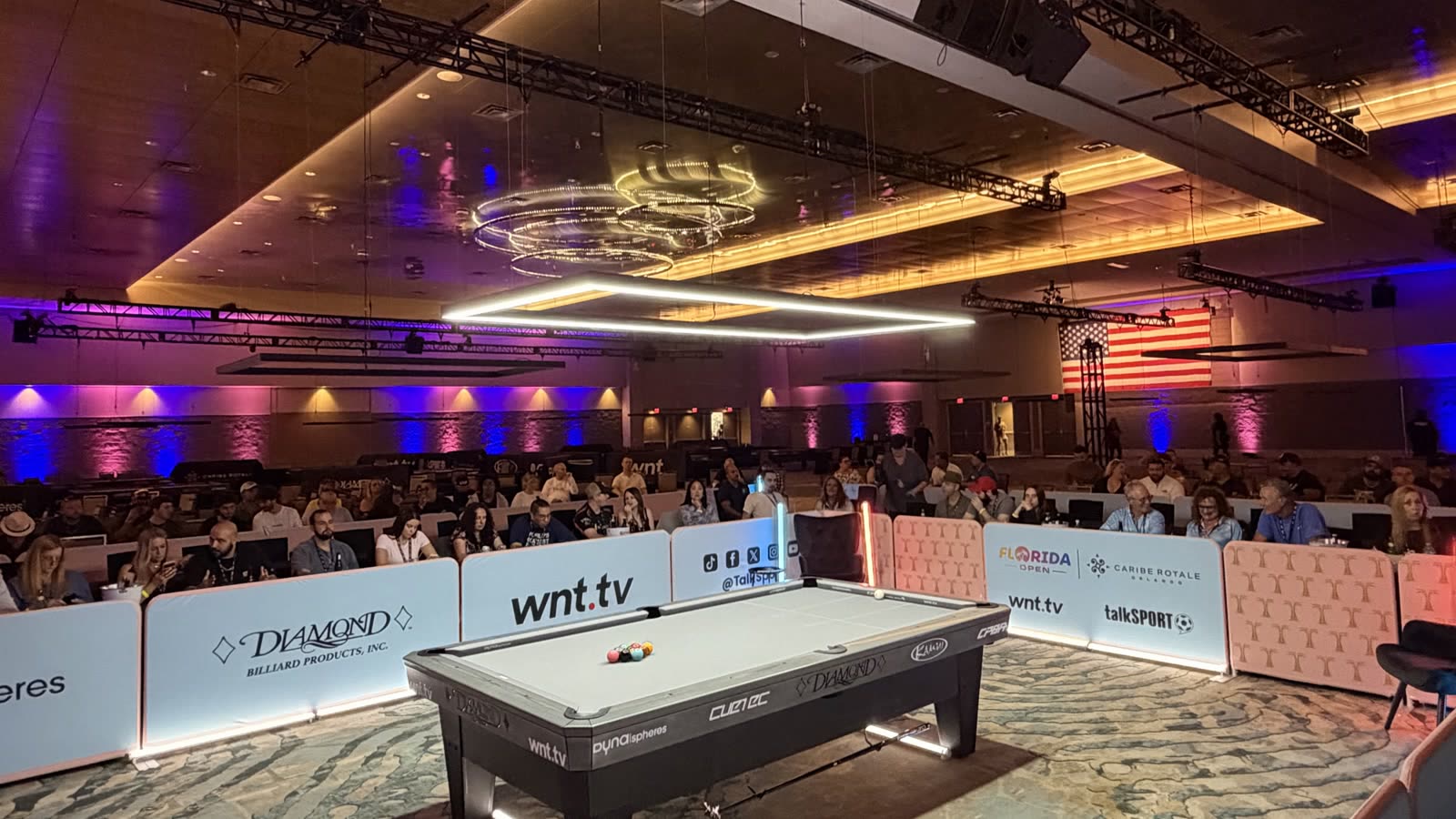
Twenty-eight tables. Four TV tables roped off in the middle, and standing there facing them, two clusters of four on your left and two more on your right — sixteen tables down the sides. Behind you, another cluster of eight. Twenty-four tables around the outside, four in the middle.
There was seating, just not the kind you’re picturing. Chairs ran around all four TV tables, and every outer cluster had its own — roughly six a side per table, so call it forty-odd chairs around each cluster of four, and about twenty-four along each side of the group of eight. A few hundred seats, but spread thin across twenty-eight tables instead of massed around one. On day one there were about as many spectators as players and people drifted in and out between racks. If you’d walked in cold you might have guessed you were at a very large league night.
Then the room contracted. Saturday afternoon it was four TV tables with 180 seats, ninety a side, and every one of them full with chairs pulled in tight — a real arena, which is a different thing entirely from chairs scattered around a room. Saturday evening it was two TV tables plus a junior table and some cocktail tables. Sunday it was one table.
I want to be honest about that arc, because the tidy version isn’t true. Saturday was the peak of the week, not the final. Sunday’s premium rows were maybe half full. The room shrank all week, and Saturday was the day it happened to fit — the field had narrowed, the seats had appeared, and it was a weekend, all at once. I’m not going to pretend I know which of those three did the work.
The other thing I didn’t expect was the quiet. Not silence exactly, but a kind of attention that a room full of amateurs never produces. I recorded one clip where the room sits at nearly nothing for seven seconds, a ball drops, and it jumps thirty-five decibels. That’s in the same continuous take. Nobody told them to be quiet. They just were, and then they weren’t.
I’ve been to two Moscone Cups, and this was nothing like that. A Moscone Cup is loud between shots and sometimes during them, and that’s the entire appeal of it — it’s supposed to be a wall of noise. Here the room policed itself. If you were in a player’s line of sight while they were down on the ball, you didn’t move. Nobody had to enforce it and there were no announcements about it. It’s just what the room did.
There was also a real disagreement running under the week that you’d never learn from watching at home. The format ran only two rounds of double elimination before going to single — the final 128 rather than the final 64, matching how the UK Open ran this year. A lot of the players didn’t like it.
The thing is, it does what it’s meant to do. Carrying double elimination deeper would have added something like another thirty-three matches, and the event would not have finished by Sunday. It’s a scheduling decision, and it works. Knowing why it’s done doesn’t seem to make anybody feel better about it, which is roughly the most human thing I saw all week. That’s the kind of thing you only get by standing around, and it was the most interesting conversation I had all week.
Three lessons for serious league players
These are the three that I think transfer. Not “watch how good they are” — things you could change on Monday.
1. When a pro misses in practice, they set it up and shoot it again
This is the one I keep coming back to, and it’s almost embarrassing how simple it is.
Watch the practice tables for twenty minutes. A pro misses a shot, and they put the balls back and shoot it again. Sometimes four or five times. Amateurs miss, make a face, and move on to the next ball.
I’ve spent years “practicing” by playing. Playing is not practicing. Practicing is the part where you go back and do the thing you just failed at, and I have been skipping it my entire pool life.
It costs nothing to fix. It’s not a technique change, it’s not equipment, it’s not talent. It’s a decision you make about forty times an hour.
2. They look at the shot from two lines, not one
The most concrete mechanical thing I saw. The stronger players consistently walk two separate lines before they get down:
- The pocket line — standing behind the object ball, looking at the pocket
- The shot line — behind the cue ball, looking at the object ball
Two different pieces of information, gathered from two different places. The very best players seem to know the angles well enough to skip it, but the majority of them, when the match matters, look from everywhere.
I’ve been walking one line. Mostly the shot line, because that’s the one that feels like aiming. Which means on any cut shot I’ve been guessing at the half of the geometry I never actually looked at.
3. A safety is two balls, not one
This came from watching the Filipino players, and it’s the one I had most backwards.
My version of a safety has always been about the cue ball. Hide it behind something and hope. One ball, one job.
What these guys are doing is playing both balls in the same stroke. They’re hiding the cue ball and they’re placing the object ball, deliberately, every time. The second half of that is the part I’d been ignoring completely.
And when there’s no clean way to hide the object ball — which is often — they don’t give up on it. They leave it somewhere it can’t do them any harm: a pot that’s genuinely hard to make, a bank that isn’t really there, or out in open space toward the middle of the table.
That last one is what took me longest to understand. I’d always assumed a ball sitting out in the open was a gift. It isn’t. An object ball near a rail is much easier to hit than one sitting out in space. The rail gives your opponent something to work with — a predictable path in off one or two cushions. A ball floating in the middle of the table with no rail near it is a genuinely hard target to find on a kick.
So the question was never just “where do I hide the cue ball.” It’s that, and also “where do I leave the object ball so that even a good hit does them no good.” Two separate problems, solved in one shot. I’d only ever been solving one of them.
That also explained something I’d noticed on day one and couldn’t account for: pro safety play and kicking are on a completely different level, and it isn’t only that they hit the kick. It’s that they were never in as much trouble as I’d have been in the same position, because the ball they were kicking at had been put there on purpose.
How this shapes Mike on the Felt
Two things, and they’re both smaller and more specific than “I got inspired.”
The first is that everything above is an argument for writing things down. Every one of those three lessons is something I noticed because I was watching closely with no other job. In a match I notice none of it, and afterward I remember almost nothing accurately — I remember how it felt, which is the least reliable data available. That’s the whole reason Pool Match Journal exists, and a week of taking notes on other people’s pool made me a lot more confident that it’s the right tool to be building.
The second is more specific, and it’s the one that surprised me.
All week I was watching positions I wanted to keep. A safety somebody played that I’d never have seen. A position route through three balls that made the whole rack look easy. A layout a player solved in a way that hadn’t occurred to me. And I had no way to keep any of it. I took photographs, which turn out to be useless a week later because you can’t tell what the balls were actually doing. I typed a few notes that made no sense at all by the time I read them back.
What I wanted was to drop the balls roughly where they were, in about fifteen seconds, and be done before the next rack started. That’s Pool Layout Journal, and six days of wishing I had it is what moved it from a someday idea to something I’m actually building. The line on its page — save the position, not the memory of it — came directly out of that week. It’s still in development, but the shape of it is up on the site.
I’m not going to pretend the trip was product research. I went because I love watching this game played properly. But six days of paying attention did sharpen what I think these tools are for.
Next steps
I’m learning the diamond system. I watched pros kick all week and it was the clearest capability gap between what I can do and what they can do, and unlike stroke quality it’s mostly knowledge rather than feel. That’s a fair trade for the drive home.
I’m also tightening my bridge, which I’d already been working on for a month before the trip and now have a much better reason to finish.
And I’m going to the US Open in Frisco, Texas, August 25–30. Same approach — no cue, more cameras, better seats if I can get them. If you’re going to be there, come say hello.
If you want the clips rather than the words, everything from Orlando is on Instagram, TikTok, and YouTube as @mikeonthefelt.